Turbidity & Chemical Treatment
Resources on reducing turbidity through flocculants, polymer treatment, dewatering, and other approaches for managing fine suspended sediment in construction runoff.
Extension Publications
Using Polyacrylamide (PAM) to Reduce Erosion on Construction Sites

This factsheet covers the use of polyacrylamides as a means of erosion control on construction sites. PAM characteristics and considerations are discussed as well as basic directions for use.
Chemical Turbidity Control in Pumped Construction Site Water

This publication describes methods to reduce turbidity and suspended solids in water being pumped into stilling basins or sediment bags, usually on construction sites where dewatering is needed.
Chemical Treatment to Control Turbidity on Construction Sites
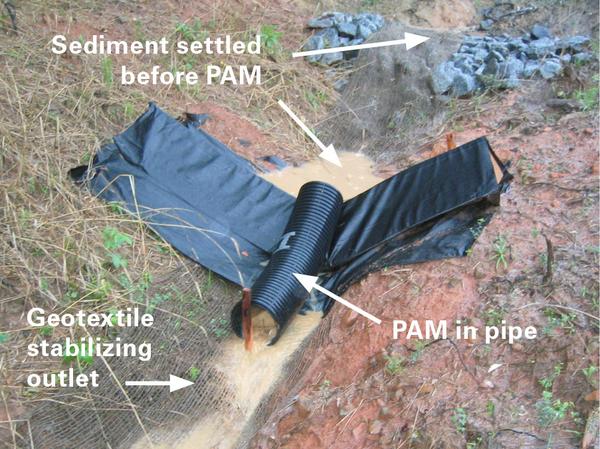
Construction sites of more than one acre are required to install systems to retain sediment produced onsite. This factsheet describes several chemical treatment options, including polyacrylamides (PAM), gypsum and alum, for reducing turbidity in impounded water.
Technical Guides & Tools
- NC DWR Approved PAMs/Flocculants List
- How to Control Turbidity on Construction Sites
- NCDOT Turbidity Reduction Options for Borrow Pits
Research Publications
- Polyacrylamide and chitosan biopolymer for flocculation and turbidity reduction in soil suspensions
Kang, J., & McLaughlin, R. A. Journal of Polymers and the Environment, 2020.
Compared polyacrylamide and chitosan for flocculating suspended soil particles and reducing turbidity.
View Article → - Acute toxicity of polyacrylamide flocculants to early life stages of freshwater mussels
Buczek, S. B., Cope, W. G., McLaughlin, R. A., & Kwak, T. J. Environmental Toxicology and Chemistry, 2017.
Evaluated the acute toxicity of different polyacrylamide flocculants to sensitive early life stages of freshwater mussels.
View Article → - Simple systems for treating pumped, turbid water with flocculants and a geotextile dewatering bag
Kang, J., & McLaughlin, R. A. Journal of Environmental Management, 2016.
Evaluated practical flocculant-assisted systems for treating pumped turbid water using geotextile dewatering bags.
View Article → - Transport of dissolved polyacrylamide through a clay loam soil
Kang, J., McLaughlin, R. A., Amoozegar, A., Heitman, J. L., & Duckworth, O. W. Geoderma, 2015.
Investigated the movement and retention of dissolved polyacrylamide through clay loam soil.
View Article → - Erosion, sediment, and turbidity control and monitoring research to meet water quality goals
McLaughlin, R. A., & Cope, W. G. North Carolina Department of Transportation, 2014.
Synthesized NCDOT-supported research addressing erosion, sediment, turbidity control, monitoring, and water quality protection during highway construction..
View Report → - Turbidimetric determination of anionic polyacrylamide in low carbon soil extracts
Kang, J., Sowers, T. D., Duckworth, O. W., Amoozegar, A., Heitman, J. L., & McLaughlin, R. A. Journal of Environmental Quality, 2013.
Developed a turbidimetric method for measuring anionic polyacrylamide in low-carbon soil extracts.
View Article → - Soil factors influencing suspended sediment flocculation by polyacrylamide
McLaughlin, R. A., & Bartholomew, N. Soil Science Society of America Journal, 2007.
Examined how soil properties influence the effectiveness of polyacrylamide for flocculating suspended sediment.
View Article →