Research & Training Facility
The Sediment & Erosion Control Research and Education Facility (SECREF) supports field-scale research and hands-on training in erosion, sediment, and turbidity control.
Facility Overview
The Sediment and Erosion Control Research and Education Facility (SECREF) is located at NC State’s Lake Wheeler Road Field Laboratory, a ~1,800-acre teaching, research, and Extension facility just minutes from main campus. Established in 2001, SECREF was among the first facilities in North Carolina, and one of only a few nationwide, dedicated specifically to improving erosion, sediment, and turbidity control practices.
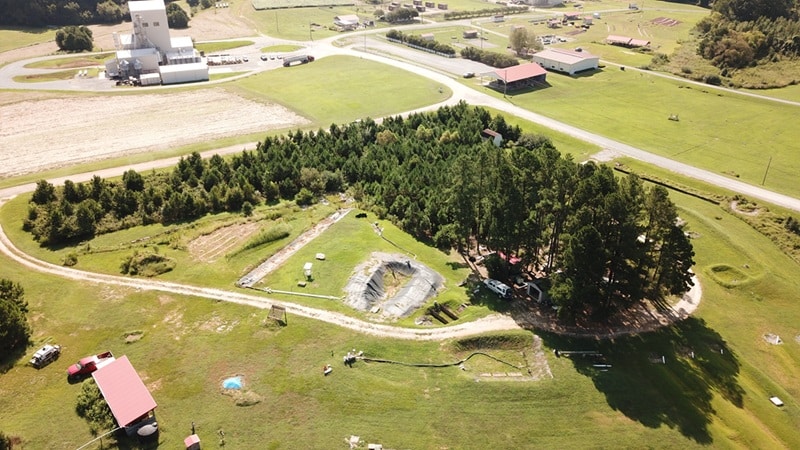
Supported by the North Carolina Sedimentation Control Commission, the former Division of Water Quality, and the US EPA Section 319 program, SECREF was developed as a dedicated setting for controlled, field-based research and professional training.
Today, the facility supports evaluation of erosion and sediment control practices under realistic field conditions while providing hands-on opportunities to demonstrate how those practices are selected, installed, and maintained.
Research at SECREF
Research at SECREF has evolved from early testing of erosion control products and flocculants to include sediment and turbidity treatment, soil restoration, stormwater hydrology, slope stabilization, construction materials, and water quality. Experimental infrastructure allows our team to control rainfall, slope, soil conditions, treatments, and runoff collection while measuring practice performance.
Research evaluates practices and materials used to reduce erosion, capture sediment, and treat turbid water from disturbed sites. This includes erosion control products, slope and wattle performance, sediment treatment systems, polyacrylamide and other flocculants, dewatering approaches, rainfall-simulation studies, and more recent work on diamond grinding slurry treatment.
Research examines how land disturbance and compaction affect soil function, runoff, infiltration, and vegetation establishment, and how those impacts can be restored. Major areas include tillage, compost and other soil amendments, roadside soil rehabilitation, infiltration recovery, vegetation establishment, and the water quality implications of post-construction soil management.
Research investigates how runoff moves water, sediment, nutrients, metals, and other pollutants through constructed and roadside environments and how management practices influence those losses. This includes stormwater control measures, detention basins, roadside runoff, pollutant transport, post-construction monitoring, and emerging water quality monitoring approaches.
Training & Demonstration
SECREF supports professional workshops, certification training, field days, and applied demonstrations that connect classroom instruction with field implementation. The facility allows participants to observe erosion, runoff, sediment transport, turbidity treatment, and BMP performance under controlled conditions.


Research to Practice
Research conducted at SECREF is incorporated into professional training, Extension publications, technical guidance, and agency and industry practice. The facility provides a direct connection between controlled field evaluation and implementation in the field.